
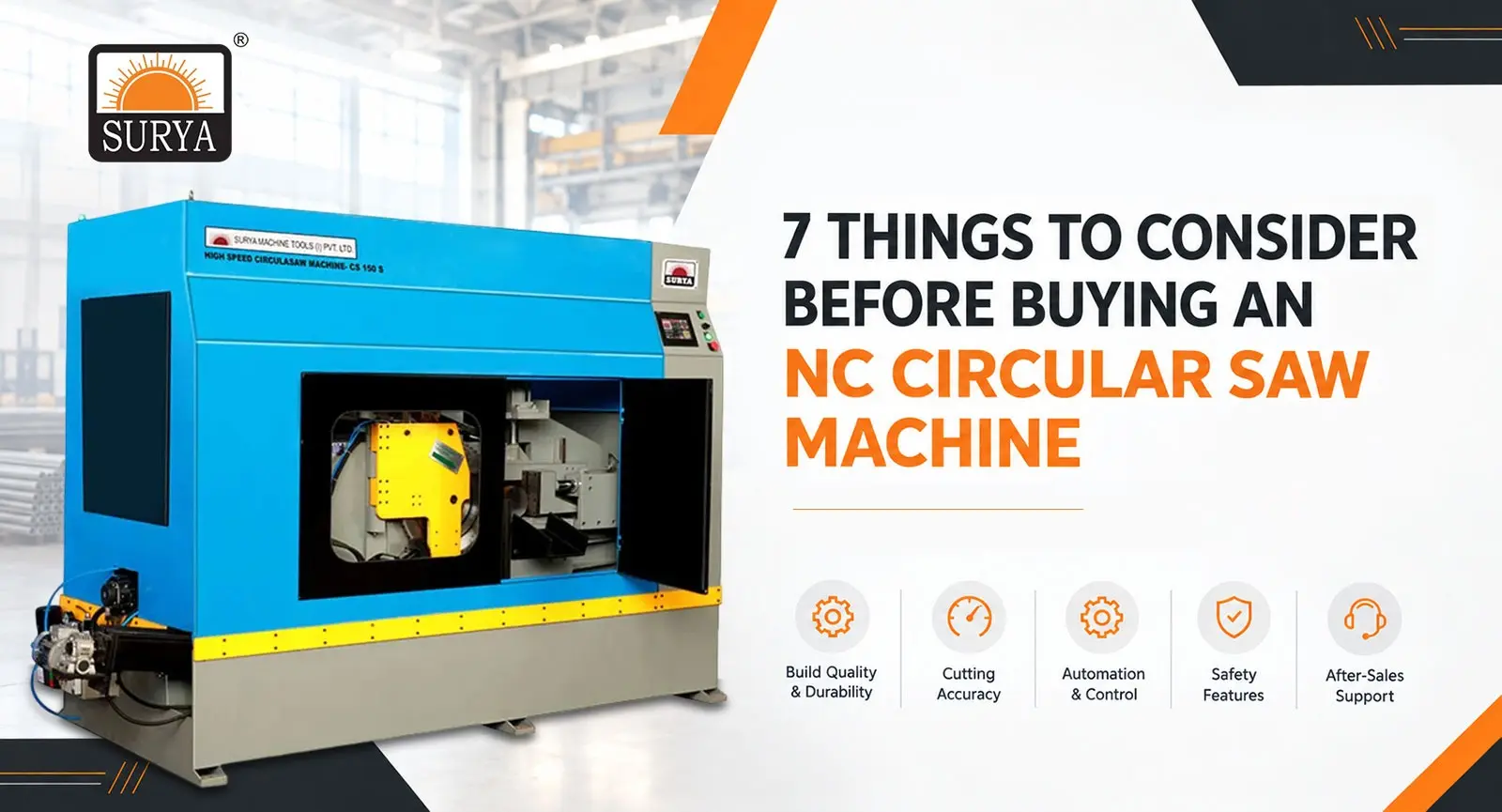
What Is an NC Circular Saw Machine

It is a numerically controlled machine used to cut metal bars, tubes, and profiles into precise lengths. Unlike a manual saw where the operator sets length and angle by hand each time, the NC system lets you program cutting length, quantity, and sometimes even cutting angle, and the machine repeats that cut accurately.
These machines are widely used in steel fabrication units, pipe manufacturing plants, and workshops that need to cut round bars, pipes, tubes, or profiles in bulk. Because the settings are pre-fed into the machine, repeat orders come out almost the same, which is something a manual saw simply cannot guarantee.
Cutting Capacity and Material Compatibility
Before anything else, check whether the machine can actually handle the material size and type you work with regularly.
- Bar diameter or profile size the machine can cut, going by a bigger capacity than your current need gives you room for future work
- Material type, mild steel, stainless steel, or non-ferrous metals, since blade selection and cutting speed change depending on this
- Cross-section shape, round bars, square tubes, or angles all put different demands on the clamping and cutting mechanism
Buying a NC Circular Saw Machine that’s just barely sufficient for today’s job usually turns into a problem the moment order sizes or material types change.
Control System, NC vs CNC
This is where buyers often get a bit confused, NC and CNC sound similar but aren’t quite the same thing.
- NC (Numerically Controlled) systems typically use basic digital controls, good for setting length, quantity, and simple repeat cuts without needing complex programming.
- CNC (Computer Numerically Controlled) systems add more flexibility, multi-axis control, angle cutting, and the ability to store multiple cutting programs for different jobs.
For straightforward, high-volume length cutting, a properly built NC machine does the job well without the added cost of a full CNC setup. CNC starts making more sense when your work involves varying angles, shapes, or frequent program changes.
Feed Accuracy and Repeatability
Accuracy is really the whole point of buying an NC Circular Saw Machine over a manual one, so this deserves close attention.
- Check the length tolerance the machine is rated for, this is usually specified as plus or minus a fraction of a millimetre
- Ask how the feed system is built, servo motor and ball screw combinations tend to hold accuracy better over long runs than simpler feed mechanisms
- Confirm whether the digital length display is easy to set and adjust, since operators will be doing this constantly through a shift
A machine that drifts slightly in accuracy after a few hundred cuts ends up costing more in rework than it saved on the purchase price.
Blade Type and Cutting Speed
The blade and speed settings directly affect both cut quality and how long the blade itself lasts.
- HSS (High Speed Steel) blades work well for general-purpose metal cutting at moderate speeds
- Carbide-tipped blades hold an edge longer and suit higher production volumes, though they cost more upfront
- Adjustable cutting speed lets the machine handle different materials without forcing one blade to do a job it isn’t suited for
Getting the blade and speed match wrong doesn’t just affect cut quality, it also shortens blade life and increases how often you’re replacing consumables.
Build Quality and Machine Rigidity
A NC Circular Saw Machine under constant vibration and load needs proper structural rigidity, otherwise accuracy and finish both suffer over time.
- Check the base frame construction, heavier, well-ribbed frames absorb vibration better during cutting
- Look at how the clamping mechanism holds the material, weak or inconsistent clamping leads to material shifting mid-cut and poor cut quality
- Ask about the guide rail and slideway quality, since this affects how smoothly the saw head travels and how long that accuracy holds up
Cheaper, lighter-built machines might look similar on a catalogue page, but rigidity differences show up clearly once the machine is running full shifts.
Maintenance Requirements and Spare Availability
An NC Circular Saw Machine needs regular maintenance, and spare part availability affects how much downtime you deal with.
- Ask about routine maintenance intervals, lubrication points, blade inspection, and slideway cleaning are typical requirements
- Check spare part lead times, especially for components like the blade, clamping jaws, and feed mechanism parts that wear with use
- Confirm whether the manufacturer stocks common spares locally, rather than needing them shipped from a distant location every time
After-Sales Support and Service Network
This factor gets overlooked often, but it matters a great deal once the machine is actually running in your facility.
- Does the manufacturer offer installation and commissioning support, or are you left to figure out setup on your own
- Is there a service team available for breakdowns, and how quickly can they respond
- Are operator training sessions offered, since proper training reduces both errors and machine wear from incorrect use
For businesses planning to buy multiple units or add more capacity later, a manufacturer with a reliable support network genuinely makes a difference over the machine’s working life.
Choosing the Right Manufacturer
Getting all seven factors right on paper still comes down to picking a manufacturer that builds the machine to match those specifications consistently, not just on the first unit, but across every order. Surya Machine Tools manufactures NC circular saw machines used across metal cutting applications, with support for material handling, blade selection, and after-sales service based on the buyer’s specific production requirement.
FAQs

Surya Machine Tools India Pvt. Ltd.
Surya Machine Tools has more than 30 years of experience in the manufacturing of cutting equipment. We provide customized and highly productive cutting solutions to our clients nationwide.
