
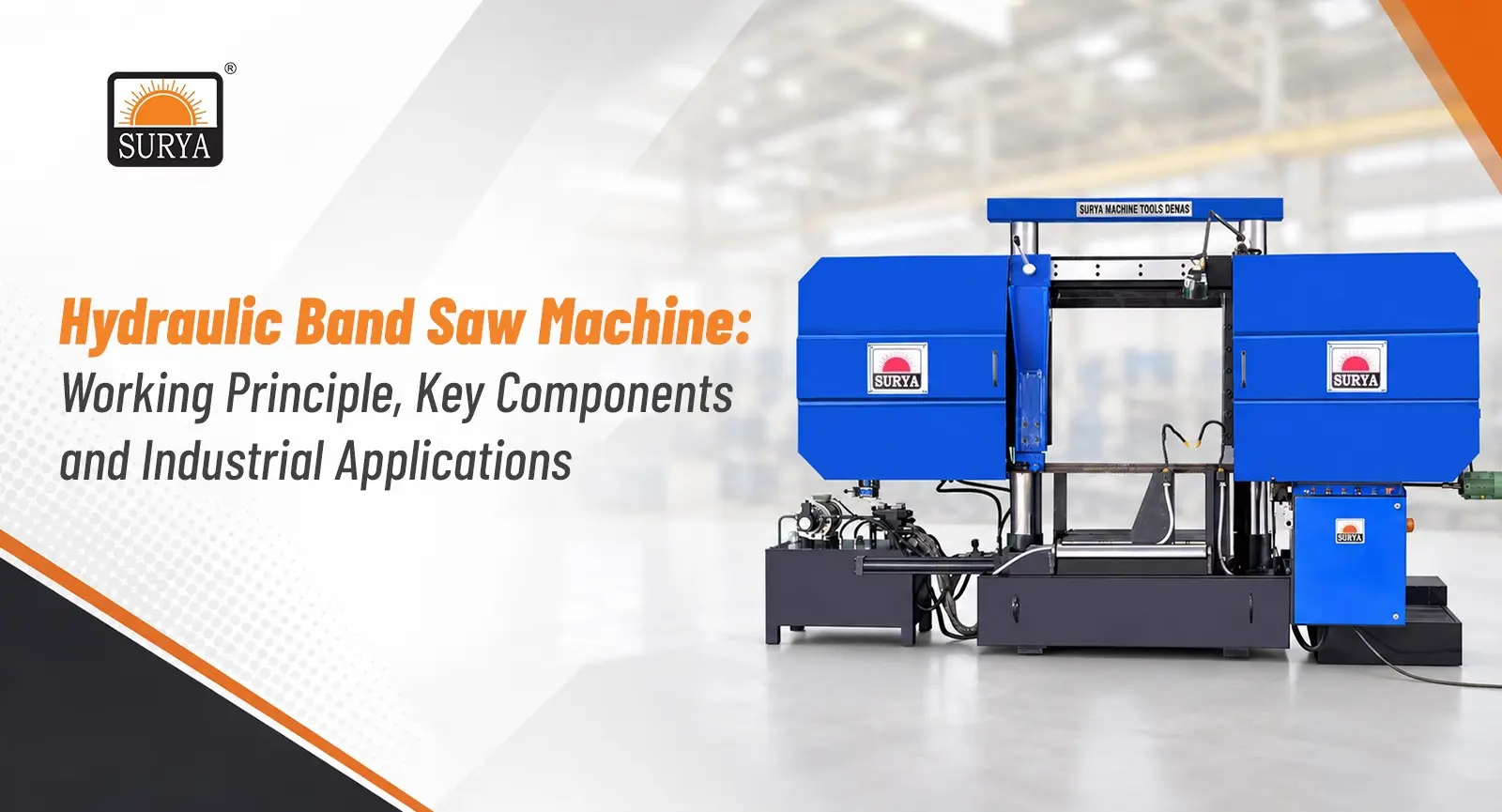
What Is a Hydraulic Band Saw Machine?

A hydraulic band saw machine is a metal cutting machine made to cut solid bars, pipes, tubes and structural sections. Its cutting tool is a thin steel band with teeth on one edge. The band is joined into a loop, and it runs over two wheels at a set speed.
It cuts mild steel, stainless steel, aluminium, brass and copper. Compared with a hacksaw or a manual saw, the cut is cleaner and the job is finished much faster.
The word “hydraulic” tells you how the machine is controlled. Instead of the operator pushing the saw into the material, a hydraulic cylinder lowers the saw frame, and a hydraulic vice holds the workpiece firmly.
How Does a Hydraulic Band Saw Machine Work?
The process is easy to follow.
- The material is placed on the table and locked in a vice.
- The operator selects the blade speed and sets the feed rate.
- The motor turns the blade wheels, and the blade starts to run.
- The hydraulic cylinder lowers the saw frame slowly onto the job.
- The blade cuts through at a steady pressure.
- Coolant flows over the blade to remove heat and wash away chips.
- When the cut is done, the frame lifts back to its starting position.
The key point is the controlled feed. A blade pushed too hard breaks, and a blade pushed too lightly rubs without cutting. The hydraulic system keeps the pressure in the right range automatically.
Key Components Explained
It is easier to understand the hydraulic band saw machine when you divide it into three groups.
The Cutting Unit
- Band saw blade: usually a bi-metal blade, which has a tough body and hard cutting teeth.
- Wheels: a drive wheel and an idler wheel that hold and move the blade.
- Blade guides: keep the blade straight as it enters the material.
- Saw frame (bow): carries the wheels, the blade and the motor drive.
- Gearbox and motor: supply power at the right blade speed.
The Hydraulic Unit
- Power pack: a pump, an oil tank and a motor that creates oil pressure.
- Hydraulic cylinder: moves the saw frame up and down.
- Flow control valve: sets the speed of the downward movement.
- Hydraulic vice: grips the workpiece.
- Hoses and filters: carry clean oil to each part.
Controls, Cooling and Safety
- Control panel: has the start, stop and speed controls.
- Coolant system: pump, tank and nozzles for cutting fluid.
- Chip brush: wipes metal chips off the blade.
- Safety guards and limit switches: protect the operator and stop the cycle at the right moment.
- Emergency stop: shuts the machine at once.
Common Machine Types
- Horizontal band saw: the most common type for cutting bars and pipes to length.
- Vertical band saw: used for contour cutting and shaping.
- Semi-automatic model: the operator loads and clamps, and the machine completes the cut.
- Fully automatic model: feeds, clamps and cuts in a repeating cycle.
- Mitre cutting model: the bow swivels to cut at angles.
- Double column model: two columns give extra rigidity for large, heavy sections.
Industrial Applications of Hydraulic Band Saw Machines
The machine is useful wherever metal has to be cut to length.
- Steel yards and service centres: cutting bars and sections for customers.
- Fabrication shops: angles, channels, beams and pipes.
- Forging and foundry units: preparing stock and cutting off extra metal.
- Automotive and auto parts: blanks for shafts, gears and axles.
- Tool rooms: cutting hard tool steel blocks.
- Pipe and tube work: straight cuts on pipes of many sizes.
- Shipyards and railway workshops: heavy sections.
- General machine shops: day-to-day stock cutting.
Cutting Problems and Easy Fixes
Most problems can be traced to a few simple causes.
- Cut is not straight: the blade may be dull, the guides worn or the blade tension low. A feed that is too fast also bends the blade.
- Blade breaks early: check the tooth pitch, the tension and the clamping. Skipping the break-in of a new blade is a common reason.
- Teeth wear out fast: the coolant may be low, or the blade speed may be too high for the material.
- Rough or wavy cut surface: the blade may be blunt, or the feed is not suited to the material.
- Feed is slow or jerky: look at the oil level and filter, and check for air in the system.
- Machine vibrates: a loose vice, loose parts or a damaged blade may be the cause.
What to Check Before Buying
- Cutting capacity: the largest round and rectangular size you need to cut, from small machines for bars of around 100 mm to heavy machines for several hundred millimetres.
- Material mix: mild steel, stainless steel and alloy steel need different blade speeds.
- Daily volume: decide between semi-automatic and fully automatic.
- Frame strength: a heavy, rigid frame reduces vibration and blade drift.
- Hydraulic quality: look for a reliable pump, smooth feed control and good filtration.
- Blade speed range: variable speed gives flexibility.
- Coolant and chip handling: a strong flow keeps the blade cool and the bed clean.
- Safety features: guards, interlocks and an emergency stop.
- Power and space: check your voltage and floor area.
- Service support: spares, blade supply and training.
Conclusion
A hydraulic band saw machine gives metal cutting the speed and accuracy that manual methods cannot match. Understanding its components and working process helps you get clean cuts and a longer blade life. Choosing the right capacity and build quality at the start protects your investment. If you are looking for leading manufacturers and suppliers, Surya Machine Tools is an ideal choice. This brand manufactures high-quality and customized band saw machines.
Frequently Asked Questions

Surya Machine Tools India Pvt. Ltd.
Surya Machine Tools has more than 30 years of experience in the manufacturing of cutting equipment. We provide customized and highly productive cutting solutions to our clients nationwide.
