
Introduction
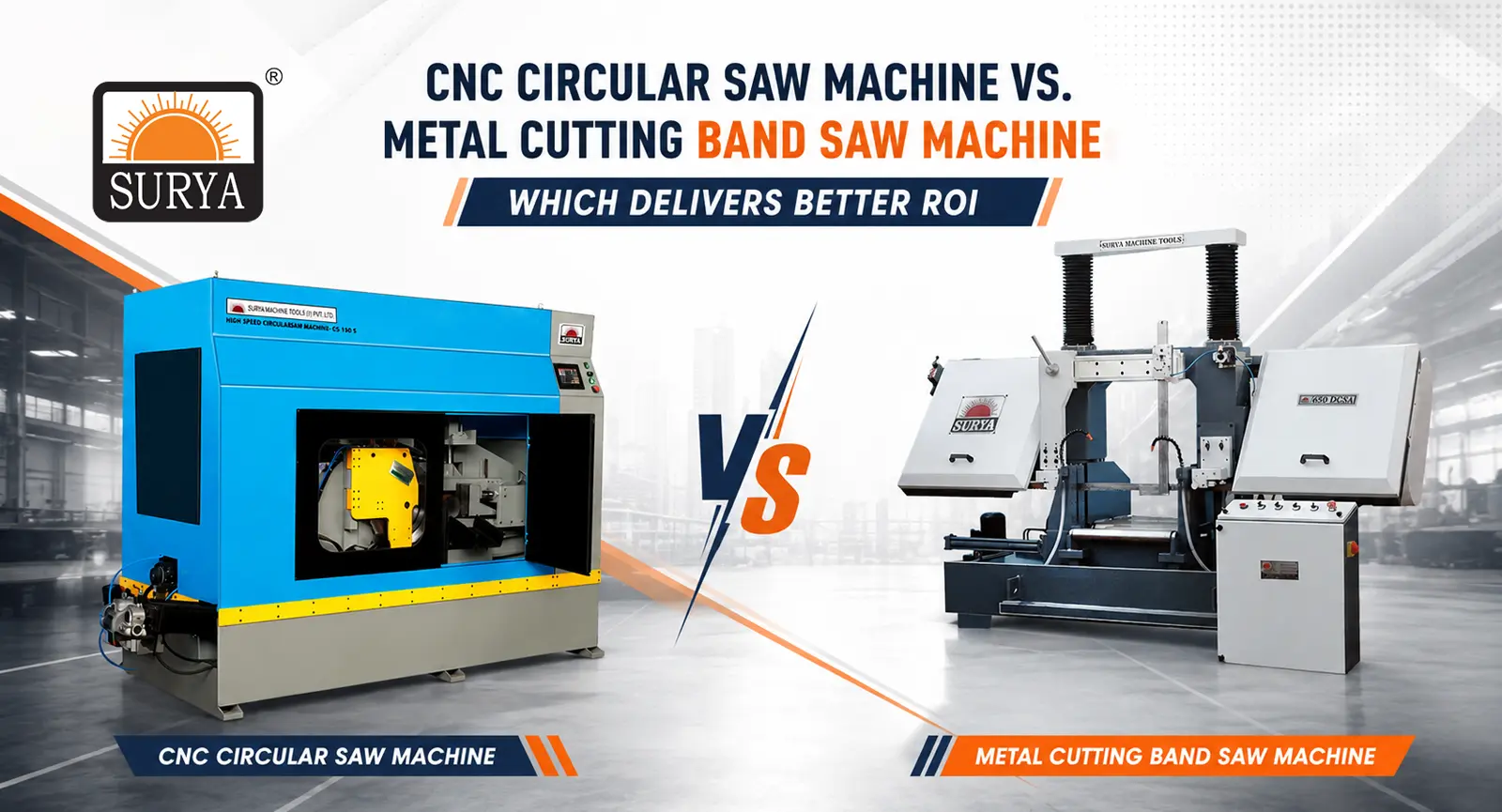
Both machines separate stock to length, but they get there through different mechanics, and that shows up directly in cost per cut. This post breaks down where each machine earns its keep and how to work out which delivers better ROI for your shop.
How Each Machine Cuts and Why It Matters for Cost?

A CNC circular saw uses a rigid, high-speed carbide-tipped blade to cut material in a single fast pass:
- Removes a wider kerf
- Needs a heavier structure to control vibration
- Draws more power to run
- Delivers fast cycle times and a clean, burr-free finish
A metal-cutting band saw machine uses a thin, continuous toothed blade in a loop between two wheels:
- Smaller kerf, so less material turns to scrap on every cut
- Slower, steadier cutting action
- Lower-cost blade that’s cheaper to replace
- Draws less power to run
That gap in kerf width and power draw is where most of the ROI difference comes from.
Where the Metal Cutting Band Saw Machine Wins on ROI?
For a large share of industrial cutting applications, this style of machine delivers better ROI than a CNC circular saw for a few specific reasons:
- Lower blade cost. Band saw blades cost a fraction of a carbide circular saw blade and last through far more cuts before replacement.
- Less material waste. A narrower kerf means less metal turned into chips — a direct saving on expensive alloys.
- Lower power consumption. It typically runs on a smaller motor than an equivalent circular saw, which adds up across a shift.
- Wider material range. One machine handles solids, tubes, bundles, and irregular cross-sections without a second machine.
- Lower upfront investment. It’s generally cheaper to buy and install, shortening the payback period.
Where the CNC Circular Saw Wins on ROI?
The picture flips in high-volume, high-repetition production, where a Metal Cutting Band Saw Machine’s per-unit savings matter less than raw speed:
- Cuts significantly faster per piece, meaning more parts per shift
- Lower labour cost per part at high production volumes
- Higher throughput can offset the machine’s higher purchase price on large batches of uniform pipe, bar, or profile
- Clean, burr-free cut can remove a secondary finishing operation
Total Cost of Ownership, Not Just Purchase Price
ROI has to be worked out over the machine’s full operating life, not the invoice price alone. The line items to factor in:
- Blade replacement frequency
- Power consumption
- Material yield and scrap rate
- Maintenance requirements
- Labour cost per part
A band saw typically scores lower on nearly every one of those line items individually. A circular saw produces more parts per hour, which can outweigh those savings once volume is high enough.
Choosing the Right Machine for Your Application
- Low-to-medium volume or mixed material — a Metal Cutting Band Saw Machine delivers faster payback and lower cost per cut.
- High-volume, uniform sections, tight cycle-time — a CNC circular saw’s throughput can justify the higher investment.
- Frequent tube, bundle, or irregular-shape cutting — its blade flexibility makes it the more practical choice.
- Need to eliminate secondary deburring — a circular saw’s finish quality reduces downstream processing.
Built for Reliable, Cost-Effective Cutting
Surya Machine Tools India Pvt. Ltd. manufactures and supplies a metal cutting band saw machine range built for consistent industrial performance, lower blade and power consumption, and long service life across a wide range of materials and section sizes. Whether you’re cutting solids, tubes, or bundled stock, the range is built to bring down your cost per cut without compromising on accuracy. To find the right machine for your production volume and material type, view the full range at https://www.suryamachines.com/metal-cutting-band-saw-machine/ or get in touch with Surya Machine Tools India Pvt. Ltd. to discuss your requirement.
Frequently Asked Questions

Surya Machine Tools India Pvt. Ltd.
Surya Machine Tools has more than 30 years of experience in the manufacturing of cutting equipment. We provide customized and highly productive cutting solutions to our clients nationwide.
